
What are you looking for today?
The Magnox Group of the ESPS has different sections. Use the tiles below to select your section and find out about your benefits.
If you're not sure which section you're in, you can find the section name on your Annual Benefit Statement (ABS), Pension Savings Statement (PSS), or your payslip (if you're already taking your benefits). Alternatively, please log in to your myESPS account and check the homepage there.
If your paperwork says SLC, please read the additional information in the boxes below to identify which tile is the correct one for you.
Final Salary sections
For members of the Atkins, Cavendish Nuclear and NNL sections.
Also for members of the SLC section who left the Scheme on or before 31 March 2024 or are a Scottish Protected Person under the Scottish Protected Persons Regulations.
Reformed SLC section
For members who were employed by NRS or Sellafield and an active member of the SLC section at 1st April 2024.
You are a member of the Reformed SLC section, which combines Final Salary and Career Average Revalued Earnings (CARE) benefits.
Knowledge Hub
For all members, this area offers general information about the Scheme, along with news updates and ways to access additional help and support.
Final Salary
Qorem ipsum dolor sit amet, consectetur adipiscing elit. Nunc vulputate libero et velit interdum, ac aliquet odio mattis.
SLC Care
Qorem ipsum dolor sit amet, consectetur adipiscing elit. Nunc vulputate libero et velit interdum, ac aliquet odio mattis.
What's happening in pensions?
Keep up to date with the latest pensions news, as well as the latest developments in the Scheme.
The new cost of retirement
11 Jun 2025
Developed by Loughborough University and the Pensions Lifetime Savings Association (PLSA), the RLS are a practical tool to help people understand what life in retirement can look like at 3 different levels: minimum, moderate and comfortable.
They take into account if you live alone or with another person, and consider things like:
- the current cost-of-living
- lifestyle choices, such as holidays, clothing and transport
- food and drink, and
- household costs, such as council tax, energy and water
The 2025 RLS updates
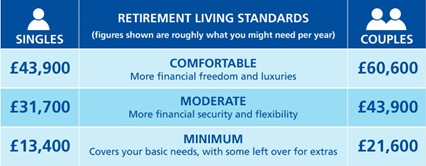
Compared to the huge increases they’ve seen in the previous 2 years, 2025 has seen smaller increases to the amounts required for moderate (+£800 per year) and comfortable (+£400 per year) standards of living, and a reduction (-£1000) to the amount required for the minimum living standard, for a single person in retirement. If you live in London, the costs are higher and can be found here.
The standards reflect changes in public behaviours, and the cost-of-living
The changes are due to a fall in the energy price cap until October 2024, and modest food price rises. Groups living to the minimum standard made cutbacks to some expenditure items, such as technology, hairdressing services, clothing, charity donations and taxi transport, and increased their budget for rail fares (from £100-£180 per year).
Amounts required to cover the weekly costs of domestic fuel have fallen across all standards by more than a quarter, for all household types. For couples living at the minimum standard, the weekly domestic fuel budget has fallen by £12.44. The moderate and the comfortable weekly budgets have fallen by £16.74. For singles living at the minimum standard, the weekly domestic fuel budget has fallen by £8.82 and the moderate and comfortable have fallen by £15.38.
The standards assume you won’t have a mortgage or rent in retirement. If this won’t be the case, you’ll need to add housing costs to your budget.
The RLS can help you plan for life after work
Based on research-backed information, they provide real-life examples for people to aim towards, empowering savers to take action by showing the level of expenditure required for different standards of living. And although all circumstances are different, and they won’t exactly reflect yours, they’re there to be used as a guide.
Using the RLS, your digital planning tools and your member website, you can take steps to secure the future you deserve
- You can use the Lifestyle calculator
This considers things like where you live, holidays and your social life, to guide you on how much you’ll need in retirement.
- You can think carefully about what you can afford and create a realistic savings goal
Research shows that by having a clear savings goal, it brings you clarity, inspires action, and you are more likely to achieve it.
- You can check if you’re on track towards your goal
You can contact Railpen, your Scheme administrator, to request an estimate of your current savings. You can also view your latest Annual Benefit Statement (ABS) in your online account.
- You can think about saving more by making Additional Voluntary Contributions (AVCs)
These are tax-free up to certain limits and can help to top-up your benefits.
Read more on the relevant pages linked below
- You can take your pension at a later age
Delaying your retirement, and working for longer, could help to build up more pension benefits.
- You can think about other sources of income, like the State Pension
The State Pension age is due to increase to 67 between 2026-2028. If you’re considering taking your pension later, the addition of your State Pension could contribute towards your income, and lifestyle, in retirement. You can read more about the State Pension by visiting gov.uk/browse/working/state-pension.
- You may find a lost pension pot or have another pension
With Pensions Dashboards launching soon, the government-backed scheme to help people trace old pension pots, you may find you have a lost pension pot. Keep an eye on the Pensions Dashboards website for any updates.
- You can get some financial advice
If you’re thinking about making changes to your pension, or taking your pension, you can speak to a financial adviser. You can find a list of Independent Financial Advisers (IFAs) by visiting unbiased.co.uk.